
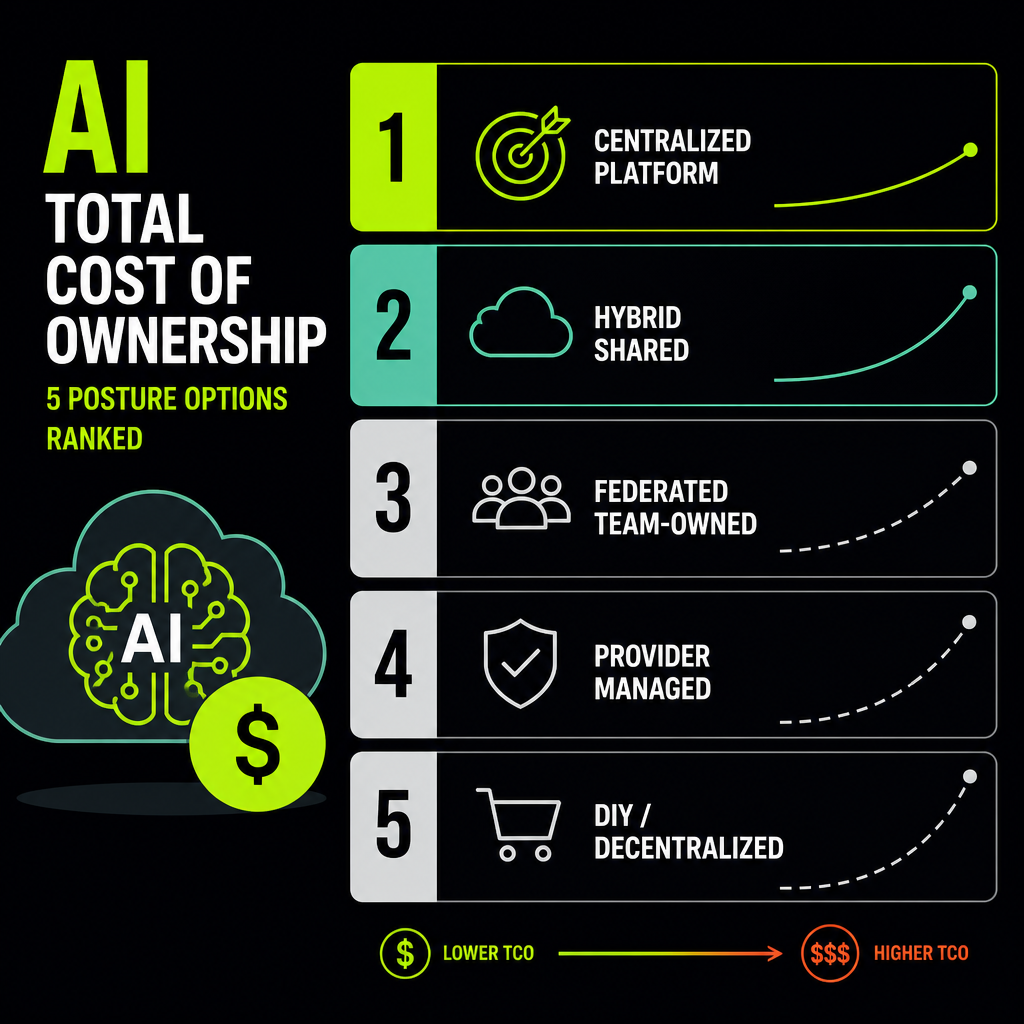
The token bill is the neat number, so it becomes the number everyone argues about. That is the wrong boundary for AI total cost of ownership. The real cost base spans model inference and data/vector infrastructure. It also includes human review and evaluation pipelines, plus compliance work and the engineering maintenance that keeps production workflows alive after launch. This ranked list is for CTOs. It also supports AI leaders and FinOps practitioners who need a standard way to track those costs across teams or client environments. The 5 posture options are ranked by attribution depth and repeatability, with governance, remediation speed, and operational overhead weighed as well.
What AI total cost of ownership includes: the hidden anatomy
Token economics matters, but treating tokens as the whole bill gives you a weak control system. A Linux Foundation analysis on AI costs puts tokens at only 10% to 25% of total AI spend once infrastructure and energy are counted, along with capital costs, software and licensing, labor, and other required costs. That range is wide because every stack is different, but the direction is clear: the visible invoice is one slice of the operating model, not the model itself.
Beyond raw API tokens: where AI capital disappears
The hidden drivers usually sit in 5 places. Inference cost grows with prompt and output length. Retry behavior and model tier add more cost pressure. Retrieval systems add storage and indexing. They also add embedding work, deduplication, and cache costs. Human review adds labor cost when quality checks require people in the loop, and the same is true for compliance work or escalation paths. Evaluation pipelines create their own inference load and data-management work. Engineering maintenance shows up in routing rules and prompt changes, along with incident work, observability, reporting, and audit trails.
Gartner also warns that generative AI ownership costs can exceed initial expectations because of unbudgeted compliance reviews and model retraining, plus internal overheads. So the practical problem is not "How do we buy cheaper tokens?" It is "How do we assign every cost driver to an owner and workload, then connect it to an outcome?"
Unit metrics: calculating AI cost per successful outcome
That owner and outcome lens matters because board pressure is moving in the same direction. A Gartner CIO survey on AI costs found that 51% of CIOs expect AI adoption to increase the total cost of ownership of technology solutions, while 58% report increased pressure to deliver cost improvement from AI. That combination makes unit metrics mandatory. Track cost per successful task and cost per accepted answer. Also track cost per reviewed case and cost per production workflow, then tie those metrics back to model and retrieval decisions, as well as evaluation and human-review choices.
Evaluation criteria for an AI efficiency posture
A strict framework keeps this from turning into a tool preference debate. The ranking below starts with a simple premise: a strong AI efficiency posture has to move from visibility to action. A dashboard that shows token spend but cannot route ownership or capture approvals, and cannot trigger remediation, is useful for diagnosis. It does not standardize operating behavior across a changing model stack.
Attribution granularity and cross-stack visibility
The first criterion is attribution granularity. A posture ranks higher when it can connect inference and retrieval costs to a workload, product surface, customer segment, or internal owner. It should also connect evaluation and human-review costs to the same accountability map. That matters because token-only reporting misses most of the economic denominator, and because hidden costs such as compliance reviews and internal operational overheads are often where accountability breaks down.
The second criterion is cross-stack visibility. You need enough context to compare a task that uses a large model directly with a task that uses retrieval and caching, plus routing and review. If the reporting model cannot see those layers together, teams will optimize the part they can measure and leave the rest alone. For model selection specifically, a task-level framework for model choice helps keep the conversation tied to workload complexity rather than model preference.
Operational repeatability and remediation governance
The third criterion is repeatability. The same tagging rules and review thresholds should work across teams or clients, and so should approval paths and exception handling, while preserving each environment's policy and decision rights. Bespoke spreadsheets can handle a first review, but they usually fail once each account has its own model stack and quality bar, as well as its own owner map and reporting cadence.
The fourth criterion is governed action. The posture should support guardrails and approvals, along with remediation and an audit trail, because AI cost controls often affect product quality. Dropping model tiers, changing retrieval depth, or sampling evaluations can save money while also changing user experience. The top-ranked option is the one that treats cost action as a controlled workflow rather than an analyst recommendation passed through chat and meetings.

Ranked summary of AI TCO posture options
The ranking favors approaches that create repeatable operating behavior before chasing isolated optimization. Model routing and RAG cleanup are useful, but they work better when the organization already has owners, guardrails, and a common reporting pattern.
| Rank | Posture option | Headline strength | Main trade-off | Best fit |
|---|---|---|---|---|
| 1 | Templated FinOps Workflows with governed action | Standardizes ownership and approvals; tracks remediation and audit state | Requires workflow design plus adoption discipline | Teams or service providers managing many AI workloads |
| 2 | Dynamic task routing and multi-model gateways | Matches tasks to appropriate model tiers | Can hide cost decisions inside proxy rules | Teams with varied task complexity and multiple model options |
| 3 | RAG infrastructure and vector lifecycle management | Controls retrieval and storage overhead | Has a narrower scope than full AI TCO governance | Retrieval-heavy products with indexing growth |
| 4 | Automated offline eval pipelines with synthetic sampling | Reduces continuous evaluation waste | Needs careful quality thresholds | Teams spending heavily on monitoring and review |
| 5 | Centralized manual audits and spreadsheet FinOps | Low tooling lift and easy start | Slow and inconsistent; difficult to scale | Early pilots or one-time finance reviews |
The order is honest rather than absolute. If your largest pain is a single runaway vector index, option 3 may be your first project. If your problem is standardization across many teams or clients, option 1 is the stronger operating posture because it gives the other optimization work a governed path to execution.
Option 1: templated FinOps Workflows with governed action
Templated FinOps Workflows rank first because they treat AI cost as an operating system problem, not a reporting problem. The goal is to define reusable patterns for attribution and approvals, along with guardrails, remediation, reporting, and audit state. Those patterns can then be applied across products or client environments without rebuilding the process each time.
This posture is strongest for AI leaders and service providers who already know how to diagnose waste but struggle to deliver the same standard everywhere. Its main strength is repeatability with control. The trade-off is setup discipline: someone has to define the ownership model and exception paths, as well as thresholds and approval rules, before automation can be trusted.
Operational mechanics: Tables, Workflows, and approvals
In practice, this posture uses Tables to hold workload metadata and owners, along with policy thresholds, exception reasons, and review state. Workflows then connect cost signals to actions. They can request approval for a model-tier change or route a remediation ticket. They can also generate a recurring report or log a decision for later audit.
The evidence for this reusable operational layer is strongest in adjacent cost operations. 2bcloud realized 10% efficiency gains using 3 workflows across a 3-week deployment, and Synyega achieved 100% infrastructure coverage with 95% tagging compliance across client environments. Those are not AI-specific savings guarantees, but they show why reusable workflow IP matters when delivery variation is the cost problem.
Option 2: dynamic task routing and multi-model gateways
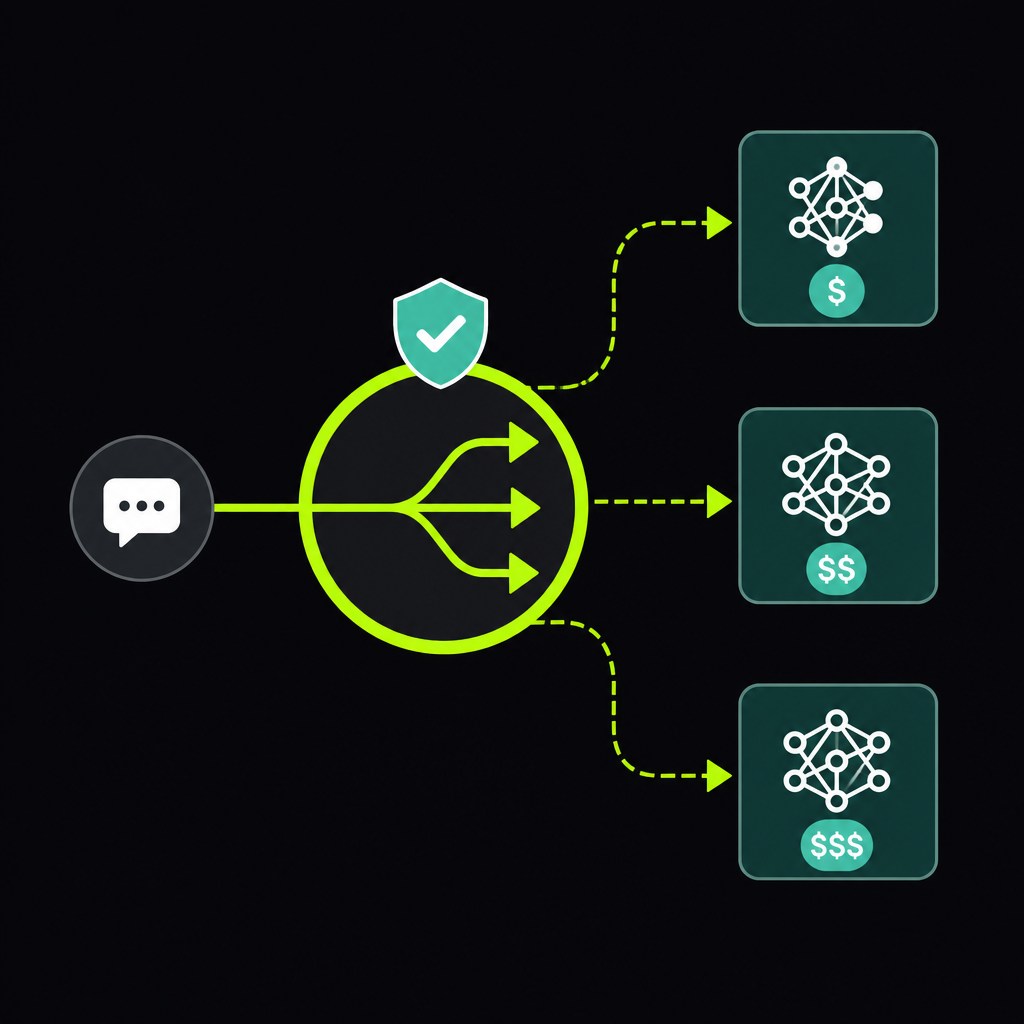
Once governance is in place, model routing is often the next visible control point. Dynamic routing ranks second because it attacks a direct cost driver: sending every task to a model tier that is more expensive than the work requires. A router can classify workload complexity, apply rules or scoring logic, and send routine tasks to cheaper models while reserving stronger models for cases that need them.
This option fits teams with a wide spread of task types, such as classification and extraction work, summarization and support drafting, or code assistance and research. Its main strength is direct control over inference mix. The trade-off is that routing can become another opaque layer if ownership and evaluation are weak, or if exception handling is weak.
The adoption signal is material. Forrester reported through model router adoption research that 86% of enterprises are evaluating or actively using model routers to align tasks with appropriate models rather than directing every workload to the most expensive tier. That does not mean routers solve AI TCO on their own. They need eval gates and policy controls, plus reporting that shows whether lower-cost routing preserved the required outcome quality.
Option 3: RAG infrastructure and vector lifecycle management
After inference mix, the next cost layer is usually data and retrieval. RAG infrastructure ranks third because it addresses costs that rarely show up in a token-only view. Retrieval-augmented generation adds embedding jobs and vector storage. It also adds index refreshes and chunking strategy, cache behavior and deduplication, plus access controls and relevance testing. Each layer can be reasonable in isolation and expensive in aggregate.
This option fits products where answer quality depends on large or changing knowledge bases. Its main strength is cost control at the data layer. The trade-off is scope. Better vector lifecycle management can reduce waste in retrieval-heavy systems, but it does not cover human review, evaluation cost, or governance over model-tier decisions.
The practical posture is to treat every collection and index, plus each refresh job, as an owned asset with a lifecycle. That means recording why the index exists and which product surface uses it. It also means recording how often the index refreshes, what quality threshold it supports, and when stale or duplicate content should be removed. Gartner's guidance to maintain a tracker for hidden generative AI expenses, including compliance reviews and retraining, plus internal overheads, applies here because retrieval systems often become long-running operational commitments rather than one-time build artifacts.
Option 4: automated offline eval pipelines with synthetic sampling
Quality measurement can become a hidden inference workload of its own, which is why automated offline eval pipelines rank fourth. Teams add LLM-as-a-judge checks and regression suites, along with sampled reviews and monitoring prompts, to protect quality. Then they lose sight of the cost of the measurement system.
This option fits teams with production AI products where quality changes are frequent and expensive to review manually. Its main strength is disciplined quality control at a lower evaluation load. The trade-off is design risk: if the sample is weak or the evaluator is poorly calibrated, a cheaper evaluation loop can create false confidence. The same risk appears when synthetic cases miss real failure modes.
A useful posture separates evaluation into tiers. High-risk workflows get stricter review and more expensive judges. Stable, low-risk workflows get sampled offline checks and smaller specialized evaluators where appropriate. Human review stays in the loop for policy-sensitive or ambiguous cases. That structure fits the broader TCO problem because it treats evaluation as a cost center with owners and thresholds, not as a free safety net attached after launch.
Option 5: centralized manual audits and spreadsheet FinOps
Centralized manual audits rank fifth because they are easy to start and hard to scale. A finance or platform team can collect invoices and ask engineering for usage context. The team can then add rough owner mappings and produce a quarterly view of spend. For an early pilot, that may be enough.
This option fits organizations with few AI workloads and limited production exposure, and with no immediate need to enforce changes across many owners. Its main strength is low initial process change. The trade-off is delay. Manual reviews tend to find issues after the spend has already landed, and the recommendation often has to travel through meetings and chat, then email, before anyone acts.
The larger problem is inconsistent attribution. Tokens may be visible, but labor and compliance review are easy to miss. So are model retraining, data-layer overhead, and internal maintenance. That is the same gap highlighted by the Linux Foundation analysis showing tokens as only 10% to 25% of total AI spend. Spreadsheets can document that gap once. They rarely create the operating muscle to close it every week.
Who should skip full AI TCO standardization
Good FinOps judgment includes knowing when heavy standardization is premature. You should skip a full AI TCO standardization program if you have one or two contained experiments and no production users. The same applies when there is no meaningful human-review process and no shared data or retrieval layer. In that case, the right move is a lightweight tracker with owner and workload, model and token spend, review labor, and known follow-up work.
You should also hold off if your organization has not agreed on what counts as a successful AI outcome. Cost per task only matters when "successful" has a stable definition. If product and legal teams, as well as support and engineering, use different quality bars, a heavy cost system can create false precision.
The same caution applies when the remediation path is politically blocked. If no one is allowed to change model tiers or reduce retrieval depth, and no one can sample evaluations or adjust review queues, better measurement will mostly create a longer list of unresolved findings. Start with decision rights. Then standardize the tracker.
Establishing an actionable AI efficiency posture
Putting the posture into production starts with the top-ranked choice, then adds the other options where the data proves they matter. A templated workflow layer gives you the control plane: owners and approvals, guardrails and remediation, recurring reports and audit trail. Model routing and RAG cleanup then become governed actions inside that layer. Eval optimization follows the same path rather than becoming a disconnected project.
The four-week operational roadmap
In week 1, define the cost taxonomy and owner model. Keep it practical. Use categories for inference and retrieval. Add human review and evaluation. Also include compliance review and retraining, with engineering maintenance tracked separately. In week 2, map those categories to the highest-volume workflows and define unit metrics such as cost per accepted answer or cost per reviewed case. In week 3, build the first governed actions, such as approval for routing changes and tagging enforcement. Add stale index review where the data shows it is needed. In week 4, publish the recurring report and audit trail, then decide which optimization work deserves automation.
Moving cost findings from visibility to action requires approvals and guardrails, remediation and recurring reports, plus audit state. No platform removes the need to define owners and decision rights. The durable advantage comes from standardizing those decisions so every new AI workload enters the same cost control system instead of becoming another custom review.
Frequently asked questions
How do I apply FinOps to AI total cost of ownership?
Apply FinOps to AI by tracking cost at the workload and outcome level, not only at the vendor-invoice level. That means assigning owners to inference and retrieval, as well as evaluation and human review. Compliance review, retraining, and maintenance work also need ownership. The reason is straightforward: tokens may represent only 10% to 25% of total AI spend once the broader cost stack is included, so a useful FinOps model needs governance and remediation paths for more than token usage.
What is AI tokenomics, and why is it insufficient on its own?
AI tokenomics is the practice of measuring and managing the cost behavior of model inputs and outputs. It covers prompt length and completion length, as well as retries and model tier. It is useful because inference spend is measurable and controllable, but it is insufficient on its own because AI ownership also includes data infrastructure and review labor, along with evaluation pipelines, retraining, compliance work, and ongoing engineering maintenance.
Which metrics should I use to measure organization-level AI efficiency?
Use unit metrics tied to successful outcomes. Good examples include cost per accepted answer and cost per reviewed case. You can also track cost per resolved support task, cost per production workflow, and cost per workflow that passes evaluation thresholds. CIO pressure supports this shift: 58% report increased pressure to deliver cost improvement from AI, while 51% expect AI adoption to increase technology TCO, so efficiency metrics need to show both cost and outcome quality.
What should my AI FinOps audit cover across the stack?
An AI FinOps audit should cover: - model usage and routing behavior - prompt and output volume - retrieval systems and vector storage - embedding jobs and cache policy - human review and evaluation runs - compliance reviews and retraining - owner mapping and exception handling - remediation history It should also test whether the organization can move from a finding to an approved action, because an audit without decision rights usually becomes another spreadsheet.