
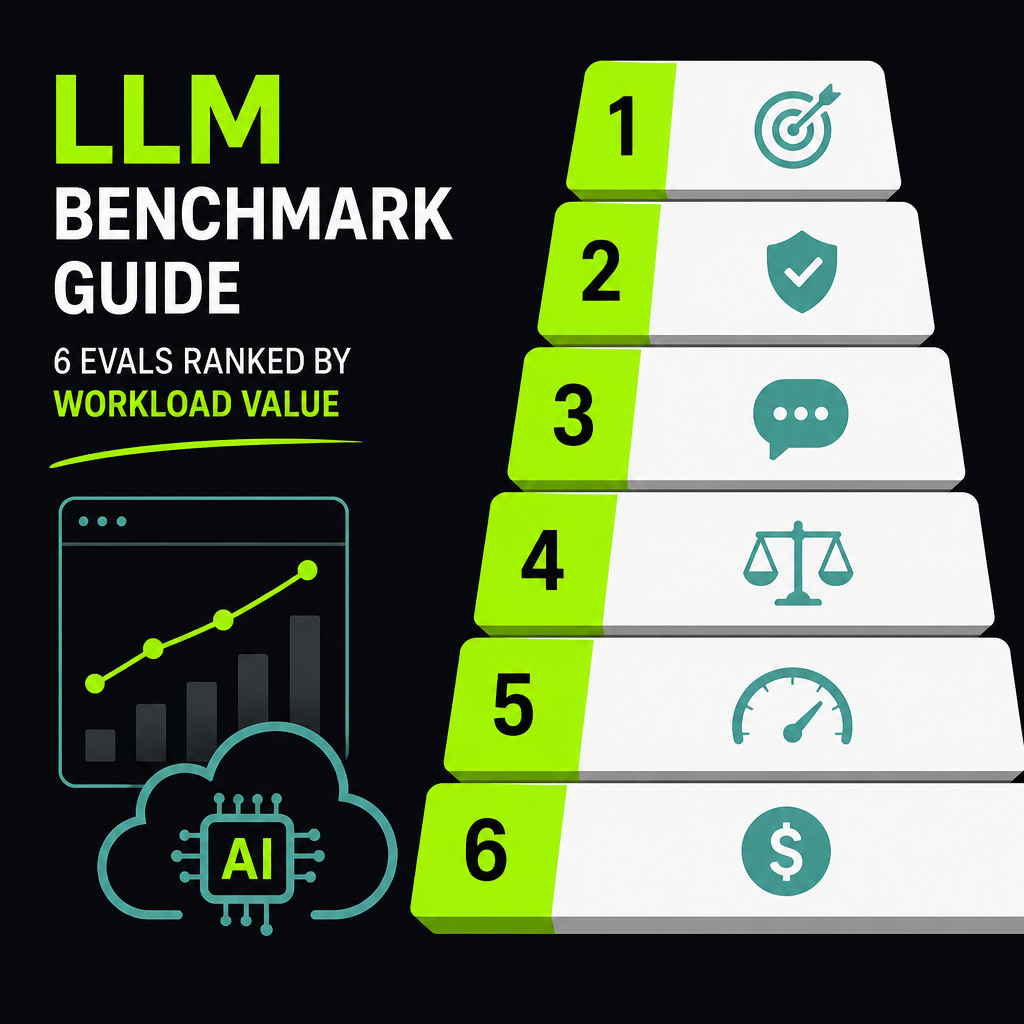
Why public leaderboard scores mislead production engineering
A leaderboard can make model selection look clean, right up to the point where failed tasks show up beside a separate invoice and timeout-rate report. Public benchmarks are useful for capability baselines, but production teams need workload-specific eval suites that measure task completion against latency and token economics. They also need to account for safety limits and operational constraints.
This ranked list is for CTOs and AI leads, as well as engineering owners choosing models for real workloads rather than press-release scores. The 6 picks below earned their place by answering a practical question: does this benchmark tell you anything useful about the work your system must finish? It also needs to reveal the failure modes you must contain and the cost profile you can defend. Public scores still matter, but they are starting points. A model that looks strong on a broad LLM benchmark may be the wrong choice for a code agent that edits repositories. The same problem applies to a support assistant that must cite policy or an internal workflow that needs approvals before taking action.
The working rule is simple: use public evals to narrow the field, then judge candidates on your own tasks. That is where model choice moves from abstract capability to workload value.
Evaluation criteria: how we scored each LLM benchmark
The evaluation rubric matters because benchmark rankings flatten very different questions into one public score. We ranked each LLM benchmark by 4 workload dimensions: task fidelity, operational realism, safety relevance, and reproducibility. A benchmark scored higher when it resembled the work a production system must complete, exposed useful trade-offs, and helped a team decide whether to pay for more model capability.
The first screen was task fidelity. A useful public eval should test behavior close to your target workload, rather than reward memorized patterns, trivia, or short answers that never touch your infrastructure. The second was cost and latency realism. A benchmark that needs long reasoning traces, repeated tool calls, or multi-step judge passes may predict quality, but it can also hide the runtime cost of reaching that quality.
The third screen was safety relevance. Agentic workloads can fail through prompt injection, unsafe tool use, package hallucination, or overconfident reasoning. A benchmark that surfaces those risks deserves more weight than one that reports a clean accuracy score without showing how the system behaves under pressure. The fourth was reproducibility. If the scoring method is opaque or unstable, it can still be useful as a market signal, but it should not decide production routing alone.
Task fidelity versus synthetic memorization
A good evaluation setup separates "the model can answer this public prompt" from "the system can complete our task under our rules." That is why you should pair benchmark scores with private examples drawn from tickets and pull requests, documents and prompts, plus policies, logs, and API constraints.
Operational cost and latency realism
Cost control depends on more than token price. You need to know how often a model retries, how many tool calls it makes, how much context it consumes, and whether a smaller model can pass the same workload gate. The same discipline applies to explanation quality: one Cloud Security Alliance scorecard on AI explainability across dimensions rated large language models 2.6 out of 5 across faithfulness, comprehensibility, consistency, accessibility, and optimization clarity. If explanations are thin, your eval suite has to measure the decision path, not the final answer alone.
For a broader model-selection process, pair this ranking with a task-level way to choose an LLM for your workload, then add your own pass/fail gates for quality and latency, with spend as its own gate.

Ranked summary: the best LLM benchmarks for workload value
Put the benchmarks side by side and the pattern is clear: the more your workload acts, edits, routes, or calls tools, the less you should trust a single public score.
| Rank | Benchmark | Headline strength | Best fit | Main blind spot |
|---|---|---|---|---|
| 1 | SWE-bench Verified | Repository-level software work | Agentic code editing | Cost and latency can rise with multi-step repair loops |
| 2 | Chatbot Arena | Human preference signal | Style, helpfulness, subjective response quality | Hard to reproduce as a production gate |
| 3 | HELM | Multi-metric capability and safety comparison | Baseline model screening | Broad coverage can still miss your tool and policy risks |
| 4 | MT-Bench | Fast dialogue sanity checks | Multi-turn assistant filtering | Judge bias can distort close calls |
| 5 | HumanEval | Isolated function generation | Basic code generation screening | Weak fit for repository context |
| 6 | MMLU | General knowledge breadth | Academic-style screening | Multiple-choice success rarely maps to operational value |
The ranking favors workload correlation over public popularity. If your use case is code repair, SWE-bench Verified gives stronger signal than broad academic testing. If your use case is brand-sensitive chat tone, Chatbot Arena may deserve more weight. If your main concern is cost routing, none of these public evals is enough on its own.
1. SWE-bench Verified: best for agentic software engineering
The top-ranked coding benchmark earns its position because of the shape of the task. SWE-bench Verified is strongest when you care about agentic software engineering, because it evaluates whether a model can reason through repository-level changes rather than produce a clean standalone snippet. That makes it a better proxy for issue resolution and bug repair, including multi-file edits, than code tests built around isolated functions.
Where SWE-bench is strongest
Its main strength is workload resemblance. A coding agent in production does not simply write a function from a prompt. It reads context and finds the relevant files before editing code. It also runs or interprets tests, and may need several attempts before the change is acceptable. A benchmark that stresses that loop gives engineering leaders a more useful baseline than syntax-only scoring.
The hidden cost and latency trade-off
The trade-off is that stronger repository performance can carry a higher runtime bill. Multi-step code agents burn tokens on context, planning, file inspection, patch generation, and retries, so a high score does not automatically mean good task ROI. Security risk also matters. A study of 576,000 AI-generated code samples across 16 LLMs found that about 20% referenced hallucinated package dependencies, and 43% of those hallucinated names were reproduced consistently across similar prompts. For code workloads, your private eval should check dependency validity, not only test pass rate.
2. Chatbot Arena: best for human preference and subjective style
Once you move from automated execution to human preference, "good" means something different. Chatbot Arena is most useful when your workload depends on how people judge responses. That includes clarity and helpfulness, as well as tone, refusal behavior, and general answer quality. That makes it a strong market signal for assistant-style products and support drafting. It also fits internal help desks and other interactions where subjective preference matters.
Standout strength: live human blind testing
The standout strength is that it captures comparative human judgment rather than a narrow answer key. If 2 models both answer correctly, people may still prefer the one that structures the response better. They may also favor the answer that handles ambiguity with less noise or asks for the right missing detail. For early model filtering, that signal can save time because it reflects the way many users experience chat interfaces.
Production trade-off: style bias and non-deterministic scoring
The trade-off is reproducibility. Human preference is valuable, but it can reward style and verbosity, or even confidence, in ways that do not match your production constraints. A model that wins subjective comparisons may still fail your policy citation test, exceed a latency budget, or produce answers that are expensive because it writes too much. Treat Chatbot Arena as a preference baseline, then run private evals against your own transcripts, escalation rules, refusal criteria, and cost limits.
3. HELM: best for multi-metric safety and accuracy
Institutional benchmarks add breadth, which is useful before you spend time building internal eval harnesses. HELM stands out because it pushes beyond one-dimensional accuracy and encourages teams to compare models across multiple behavioral dimensions. For AI leaders who need a baseline view before narrowing the candidate set, that breadth is the value.
Standout strength: broad multi-dimensional baselines
Its standout strength is coverage. Broad evaluation suites help teams avoid picking a model because it performs well on one narrow test. If your organization supports several workloads, such as summarization, question answering, content classification, and code assistance, a multi-metric baseline can expose obvious weak spots before you spend engineering time on private test harnesses.
Production trade-off: instruction following versus attack surface
The trade-off is that broad capability can hide workload-specific attack paths. Agentic systems face risks that ordinary accuracy tests do not capture, especially when the model reads untrusted input and can call tools. Independent benchmarking under MCPTox found prompt injection attack success rates as high as 72.8%, and the researchers tied that vulnerability under instruction injection to strong instruction-following fidelity. That is the uncomfortable part: a model that follows instructions well may also follow malicious instructions well unless your system adds tool permissions and input isolation, with approvals and audit trails.

4. MT-Bench: best for quick multi-turn dialogue sanity checks
Automated judges are useful when you need a fast first pass before spending reviewer time. MT-Bench fits that role because it gives teams a structured way to compare multi-turn dialogue behavior without building a full human review operation for every candidate model.
Standout strength: low-cost two-turn validation
Its standout strength is speed. For teams evaluating assistant behavior, a quick multi-turn check can reveal whether a model loses context, ignores the second instruction, answers in the wrong format, or responds with too much generic filler. That is useful before you wire the model into a full product workflow.
Production trade-off: position and verbosity bias
The trade-off is judge dependence. Any LLM-as-a-judge setup can inherit the judge model's preferences, including preference for longer answers or sensitivity to response order. That does not make the benchmark useless, but it does mean you should avoid using it as a final routing rule. Use it to reject weak candidates, then test surviving models on your own conversations, with your own answer length limits and escalation rules, plus your latency budget.
5. HumanEval: best for isolated function generation baselines
Legacy coding benchmarks still show up in evaluation plans, and HumanEval remains useful for a narrow question: can a model produce a small function that passes unit tests? For basic code generation screening, that is a clean and easy signal.
Standout strength: zero-effort automated unit tests
The standout strength is simplicity. HumanEval-style tests are easy to run, easy to score, and easy to compare. If your workload is limited to short programming prompts and basic syntax, with isolated function completion as the target, it can catch models that should not make the shortlist.
Production trade-off: contamination and lack of repository context
The trade-off is fit. Modern coding assistants often need repository context, dependency awareness, test interpretation, and multi-file edits. HumanEval does not model those constraints, so a high score can create false confidence for agent pipelines. Use it as a low-cost screen, then move quickly to repository tasks, package checks, security scans, and human review for risky changes.
6. MMLU: best for general knowledge screening
Standardized academic baselines put MMLU in the right place: useful, but easy to overvalue. It is a broad general-knowledge screen, which makes it helpful when you need a quick read on academic-style reasoning across domains.
Standout strength: standardized academic breadth
The standout strength is comparability. Because MMLU is widely recognized, it gives technical buyers a shared reference point when comparing candidate models. That is useful in early filtering, especially when a team has not yet built private evals.
Production trade-off: multiple-choice disconnect from operational tasks
The trade-off is that many production workloads are not multiple-choice exams. They involve incomplete context and tool calls, along with uncertain inputs, private data, cost ceilings, and decisions that need owners. A model can score well on broad knowledge and still be the wrong economic choice for a narrow workload where a smaller model completes the task within the same quality threshold. If you are evaluating AI total cost of ownership, treat MMLU as background signal rather than a reason to accept materially higher inference spend.
Who should skip public LLM benchmarks entirely
Some teams should spend almost no time debating broad benchmark order because their workload has constraints public tests do not model. In those cases, the useful question is not which model tops a public table. It is whether a candidate can operate inside your permissions and risk model, as well as your latency budget and cost ceiling.
Proprietary schemas and internal APIs
Skip public leaderboard-driven selection when your system depends on private schemas, internal APIs, customer-specific policies, or tools the public eval cannot see. In those cases, the meaningful test is whether the model can map your inputs to your actions under your permissions. A public score may still help choose a starting set of models, but it should not decide production access.
Strict latency budgets and edge compute constraints
You should also skip benchmark-first selection when deployment location or deterministic behavior matters more than broad capability, or when latency is the hard limit. Edge inference, real-time user flows, high-volume classification, and strict budget caps often reward smaller or specialized models. The right answer may be a routing policy: use a lower-cost model for simple tasks and escalate only when confidence drops. Human approval should be required before expensive or risky actions.

Frequently asked questions
What is the best LLM benchmark for coding?
For agentic software engineering, SWE-bench Verified is the strongest public signal in this ranking because it is closer to repository-level work than isolated function tests. Still, code evals should include security checks. Research on AI-generated code found that about 20% of samples referenced non-existent Python or JavaScript packages, so a private coding suite should verify dependencies and not stop at whether generated code looks plausible.
What does an LLM evaluator measure?
A public evaluator measures a defined slice of model behavior, such as accuracy, preference, dialogue quality, coding performance, or safety behavior. The useful question is whether that slice matches your workload. Explainability is a common gap: one scorecard rated large language models 2.6 out of 5 across faithfulness, comprehensibility, consistency, accessibility, and optimization clarity, which means teams still need their own checks for why a model answered the way it did.
Why do top-scoring models fail in production agent workflows?
Top-scoring models can fail because production agents face tool permissions and untrusted inputs, plus private context, latency budgets, and cost limits that public benchmarks may not include. Strong instruction following can also increase risk. MCPTox testing found prompt injection attack success rates reaching 72.8%, which shows why agent evals need adversarial prompts and tool-call controls, with approvals and audit trails.
How should I route LLM queries across cost, latency, and quality?
Route by workload policy rather than model prestige. Define quality thresholds for each task and set latency and spend ceilings. Send simple requests to lower-cost models, then escalate only when the task requires more capability or confidence drops. The routing decision should be logged so engineering and product owners, plus finance owners, can see why the system chose a model and when a guardrail fired.